Links

District Administration Magazine Webinar on Blended Learning…..check it out

Blended learning – the powerful combination of real-time and online interaction— is being adopted across the country to improve math teaching and student learning. By implementing an online supplemental math program that utilizes intelligent adaptive learning™ technology, your school or district can easily and effectively provide personalized instruction in the classroom and at home for all students, regardless of level or ability. Attend this web seminar to learn how to get started with blended learning and the keys to successfully adopting this latest technology to improve achievement of your elementary math students.

Topics will include:

  • The importance and efficacy of blended learning
  • Evaluating curriculum and blended learning model options
  • The latest and most effective technology used in elementary-level mathematics

http://www.districtadministration.com/webseminar/principal%E2%80%99s-guide-blended-learning-elementary-mathematics

Links

7 Excellent iPad Games to Develop Kids Critical Thinking

This is a great site that I found online and wanted to share it with my readers. They have PHENOMENAL resources for a teacher and students. You can check their resources at http://www.educatorstechnology.com/ or by clicking on the link.
There is an app for everything these days. From health apps to travel apps, iTunes market is teeming with all kinds of apps. It only takes one click in a search engine to find what you want but as we always say not every app can do what its developers preach , you need to have a critical eye to evaluate the apps that will work for you. As teachers and educators, we are in a constant search for apps to use with our students and this is why we need to make sure we have recourse to checklists such as this one whenever we are to recommend apps.
Educational Technology and Mobile Learning has even made it way easier for teachers to pick the apps they want from some pre-made lists of apps organized according to each subject area. You can check them HERE.
In today’s post , we are providing you with a list of great games designed to improve your students critical thinking and creative powers.Check them out below and don’t forget to check the list we have posted before on iPad  Apps to Develop Kids Critical Thinking.
1- Feed the Head

 ” The iPad adaptation of our classic surrealist toy! Poke the Head. Prod the Head. Tug the Head… but most importantly, Feed the Head. Like a living cartoon, the Head will unfold and transform in surprising, startling, and hilarious ways.”


2-Where’s My Water

 ”Where’s My Water? is a challenging physics-based puzzler complete with vibrant graphics, intuitive controls, and a sensational soundtrack. To be successful, you need to be clever and keep an eye out for algae, toxic ooze, triggers, and traps. ”


3- RoomBreak

“Room Break is an adventure game about escaping.The purpose of this game is simple.Users will be detained to certain places and situations and they need to open the door of each room and escape.”

4- Cross Fingers Fee

 ”Mobigame, the team behind the multiple award winning EDGE for iPhone and iPod touch, returns in full force with Cross Fingers, a unique game which challenges you to combine solid pieces in a gigantic tangram puzzle”

5- Doodle Fit

 ”The task in Doodle Fit is simple: fit the given sets of blocks into the given shapes. Drag the blocks into positions in search for the layout that covers the whole shape. A level is complete when all blocks have been used and there is no more space free in the shape..”

6- Jelly Car

“JellyCar is a driving/platforming game for both iPhone and iPod touch. The game is about driving a squishy car through squishy worlds, trying to reach the exit. JellyCar features soft body physics for all of the objects in the world. Also your car can transform for a limited time to aid progression through the level ”7- Geared for iPad

 ”Geared is a radically new and innovative puzzle game; a unique addition to its genre. The first and only Gear-based game with absolutely no snap-grid. Geared delivers complete and total freedom to the player, bestowing every puzzle with a near infinite array of choices. ”

8- 7 Little Words 

 ”7 Little Words is FUN, CHALLENGING, and EASY TO LEARN. We guarantee you’ve never played anything like it before. Give 7 Little Words a try today!”
Links

Smarter Balance Consortium updates Technology Requirements for Assessments…..

The Smarter Balanced Assessment Consortium has released an updated guide to technology requirements and recommendations for member states planning to implement the common core assessment system the consortium is developing for the 2014-15 school year.

Under the framework, most schools should be able to implement the assessments, the organization said. However, schools that meet only the minimum specifications for the assessments may experience lag times and delays, while schools that implement the recommended guidelines for technology will experience a faster, more seamless assessment experience. However, the organization asserts that the lags and delays will not affect the quality of the assessments, only the amount of time it takes to process students’ responses.

The document makes five recommendations to prepare schools for the new assessments.

1. Move away from Windows XP (which is currently used by more than half of schools today) to Windows 7. Windows 8 might be acceptable, but further testing is needed. However, the assessments will work with Windows XP.

2. Upgrade computers to at least 1 GB of internal memory. Most schools have already implemented this recommendation (63 percent, to be exact.)

3. Make sure that all screens being used for the assessments have a visual display of no less than 9.5-inches, with at least a 1024 x 768 resolution. About 88 percent of schools have already met this recommendation. The assessments could work with an 8-inch screen, but 9.5 inches is the recommended width, the document says. Schools should also consider the dimensions of the actual visual screen if using tablets with an on screen keyboard, the document recommends, suggesting that schools provide plug-in keyboards to take full advantage of the screen.

4. Make sure the student testing site operates on secure browsers. While data reports from the assessments can be accessed through Google Chrome, Safari on iOS, Firefox, and Internet Explorer 8, the organization will release secure browsers each year that will be required for the actual test-taking. These browsers will prevent students from being able to access anything except the exam, and it will prevent them from copying and pasting or taking screenshots. The browsers will need to be installed every year prior to the assessment dates.

5. The assessment requires about 5-10 Kbps of bandwidth per student. The amount of bandwidth needed will depend on the assessment, some of which include animations, recorded audio, and other technology-enhanced items. Schools should estimate about 1 Mbps for every 100 students taking the assessment, keeping in mind that the school may be using additional bandwidth for other functions within the school during assessment periods.

For a full list of minimum technology requirements along with Smarter Balanced’s current recommendations, download the report here.


By Katie Ash on December 4, 2012 5:20 PM

15
Dec 2012
POSTED BY Jeff
POSTED IN

Articles

DISCUSSION No Comments
TAGS

Links

A+ Schools Infuse Arts and Other ‘Essentials’ (Edweek repost)

A+ Schools Infuse Arts and Other ‘Essentials’

This is a great article that speaks to the fact that we all need to explore our creative side.

As a group of Oklahoma principals toured Millwood Arts Academy on a recent morning, they snapped photos of student work displayed in hallways, stepped briefly into classrooms, queried the school’s leader, and compared notes.

They were gathered here to observe firsthand a public magnet school that’s seen as a leading example of the educational approach espoused by the Oklahoma A+ Schools network, which has grown from 14 schools a decade ago to nearly 70 today.

A key ingredient, and perhaps the best-known feature, is the network’s strong emphasis on the arts, both in their own right and infused across the curriculum.

“I took a million pictures today and emailed them to all my teachers,” said Principal Leah J. Anderson of Gatewood Elementary School, also in Oklahoma City.

Ms. Anderson said she was struck by the diverse ways students demonstrate their learning, such as a visual representation of the food chain displayed in one hallway.

“It’s not just a page out of the textbook,” she said. “They created it themselves.”

The Oklahoma network has drawn national attention, including praise from U.S. Secretary of Education Arne Duncan and mention in a 2011 arts education report from the President’s Council on the Arts and the Humanities.

The A+ approach was not born in Oklahoma, however. It was imported from North Carolina, which launched the first A+ network in 1995 and currently has 40 active member schools. It has since expanded not only to Oklahoma but also to Arkansas, which now counts about a dozen A+ schools. Advocates are gearing up to start a Louisiana network.

What’s Essential?

Schools participating in the A+ network in Oklahoma and other states commit to a set of eight A+ essentials.

Arts
Taught daily. Inclusive of drama, dance, music, visual arts, and writing. Integrated across curriculum. Valued as “essential to learning.”

Curriculum
Curriculum mapping reflects alignment. Development of “essential questions.” Create and use interdisciplinary thematic units. Cross-curricular integration.

Experiential Learning
Grounded in arts-based instruction. A creative process. Includes differentiated instruction. Provides multifaceted assessment opportunities.

Multiple Intelligences
Multiple-learning pathways used within planning and assessment. Understood by students and parents. Used to create “balanced learning opportunities.”

Enriched Assessment
Ongoing. Designed for learning. Used as documentation. A “reflective” practice. Helps meet school system requirements. Used by teachers and students to self-assess.

Collaboration
Intentional. Occurs within and outside school. Involves all teachers (including arts teachers), as well as students, families, and community. Features “broad-based leadership.”

Infrastructure
Supports A+ philosophy by addressing logistics such as schedules that support planning time. Provides appropriate space for arts. Creates a “shared vision.” Provides professional development. Continual “team building.”

Climate
Teachers “can manage the arts in their classrooms.” Stress is reduced. Teachers treated as professionals. Morale improves. Excitement about the program grows.

The networks are guided by eight core principles, or “essentials,” as they’re called, including a heavy dose of the arts, teacher collaboration, experiential learning, and exploration of “multiple intelligences” among students. At the same time, each state has some differences in emphasis.

Oklahoma’s network describes its mission as “nurturing creativity in every learner.”

The nearly 20 educators who toured Millwood Academy this month—part of a larger group attending a leadership retreat for the state network—covered the gamut from those brand new to the A+ approach to others with years of experience.

“The continual plea from people seeking to do things like this is, ‘Show me, demonstrate,’ ” said Jean Hendrickson, the executive director of Oklahoma A+ Schools, which is part of the University of Central Oklahoma in Edmond.

“[This] is one of the handful of A+ schools we can count on to actively, any day of the week, demonstrate this model in action,” she said at Millwood. “What we want is for the others in our network to have their feet on the ground in a place like this.”

The network faces continual challenges, such as attracting sufficient state aid and coping with the inevitable turnover of school staff, which can strain the degree of fidelity to the A+ essentials.

This fall, 16 member schools in Oklahoma have new principals, more turnover than ever. Some of them lack prior experience with A+, including Consuela M. Franklin, who just took the reins at Owen Elementary School in Tulsa.

“I inherited an A+ school, and so my quest today is to actually learn more, the overall philosophy,” she said. “What it looks like. What it sounds like. How do you know it when you see it?”

Desire to Change

The Oklahoma A+ network has a diverse mix of schools in urban, suburban, and rural areas. Some serve predominantly low-income families. Most are public, though a few are private. And they include traditional public schools, as well as magnets and charters.

The network is supported by both public and private dollars, with all professional development and other supports free to participating schools. But state funding was cut back sharply during the recent economic downturn. An annual line item in the state budget for the network that at its height provided $670,000 was zeroed out in 2011. In the latest budget, it was restored, but only at $125,000.

Schools are drawn to A+ for diverse reasons, said Ms. Hendrickson, who was a principal for 17 years before becoming the network’s leader. But it all boils down to one thing: a desire to change.

“What they want to change ranges broadly,” she said. “It can be they want better test scores. It could be richer activity-based, project-based-learning ideas. It could be taking their success to the next level. It could be more arts.”

As part of the application process, a school must gain the support of 85 percent or more of its faculty members before a review by A+ staff and outside experts. The review is focused mainly on gauging the school’s commitment and capacity to effectively implement the A+ essentials.

The level of fidelity to the approach varies across schools, Ms. Hendrickson said, adding that even within the same school, it may shift over time. “Schools are not static places,” she said.

“Over time, [A+ schools] tend toward one end or the other of our engagement spectrum, whether the informational end, ‘Thank you, we got what we wanted,’ or the transformational end, where, ‘It drives what we do,’ ” she said. “So we have different levels of engagement and different categories of affiliation.”

One teacher at the A+ retreat confided that with a recent leadership switch at her school, the commitment level has declined.

“It’s not the same if you don’t have a leader who is completely active and passionate about it,” she said. “So it has changed, but we’re hanging in there.”

Gary Long, 8, leads his fellow 3rd graders in spoken word poetry, quotes and chants as principals from other area schools record video on their iPads during a tour of the Millwood Arts Academy in Oklahoma City, Okla. State education leaders recently toured to get a first-hand view of the school’s program that infuses arts across the curriculum.
—Shane Bevel for Education Week

The tightest alignment comes with “demonstration schools.” Those schools, including Millwood Arts Academy, have “made a really strong commitment to the eight A+ essentials, and they are our best partners to help others see what it looks like,” said Ms. Hendrickson.

Millwood is a grades 3-8 magnet that primarily serves African-American students from low-income families. Unlike most Oklahoma A+ schools, it has selective admissions criteria. Admission decisions primarily are reflective of strong student interest in the arts and parents’ embrace of the school’s philosophy, said Christine Harrison, the principal of both that school and Millwood Freshman Academy, which is in the same building and is also an A+ school.

Speaking to her visitors this month, who saw classes for both academies, she sang the praises of the network: “A+ is our driving force.”

Ms. Harrison, who describes her schools as “dripping in the arts,” also emphasized the power of the other A+ essentials, including the intentional collaboration.

“We have teachers collaborating without me having to say ‘collaborate,’ ” she said. “You cannot be isolated in an A+ school.”

‘Shared Experience’

Following the trip to Millwood, the visiting educators spent time sharing ideas and exploring best practices. At one point, the principals sat down in small groups for an intensive, problem-solving exercise. Each leader identified a particular challenge and worked on strategies to cope.

“We provide ongoing professional development and networking opportunities, with a strong research eye on the methods we’re using, the outcomes we’re getting,” said Ms. Hendrickson.

Sandra L. Kent, the principal of Jane Phillips Elementary in Bartlesville, Okla., gives high marks to the professional development, especially the five-day workshop for schools first joining.

“We had a really powerful shared experience,” she said. “That’s one thing, as an A+ school, when you all go and live together for a week.”

Dance instructor Beth Eppler teaches her students how to solve math equations by counting their dance steps in a class at the Millwood Freshman Academy in Oklahoma City, Okla.
—Shane Bevel for Education Week

Ms. Kent said A+ is often misunderstood as being an “arts program.” The arts dimension gets significant attention “because not a lot of other people talk about it as being so important.” But other elements are also important, she said, such as the call for collaboration and the pursuit of multiple learning pathways that attend to students’ “multiple intelligences.”

Another ingredient is enriched assessment strategies that aim to better capture what students know and are able to do.

One aspect that has helped get A+ schools noticed is the research base.

“They have a very strong evaluation component,” said Sandra S. Ruppert, the executive director of the Washington-based Arts Education Partnership. “They have made the investments, documented their strategies. They can look at the correlation with test scores, but also a whole host of other outcomes. … It is what gives that work greater credibility.”

Both the North Carolina and Oklahoma networks have been the subject of extensive study.

In 2010, Oklahoma A+ Schools issued a five-volume report on data collected by researchers from 2002 to 2007. It found that participating schools, on average, “consistently outperform their counterparts within their district and state on the [Oklahoma] Academic Performance Index,” a measure that relies heavily on student-achievement data.

The study also found other benefits, including better student attendance, decreased disciplinary problems, and more parent and community engagement. But it found the level of fidelity to the A+ essentials uneven, with those schools that adhered most closely seeing the strongest outcomes.

Meanwhile, a separate, more limited study in Oklahoma City compared achievement among students in A+ schools with a matched cohort of students. It found that, on average, students across the seven A+ schools “significantly outperformed” a comparable group of district peers in reading and math, based on 2005 test data. However, not all individual schools outperformed the average, and the study did not measure growth in student achievement over time.

Tapping Into Creativity

Amid growing interest in A+, neighboring Arkansas is ramping up its network, after stalling for a few years. Just recently, several charter schools in the high-profile KIPP (Knowledge Is Power Program) network signed on.

“People think KIPP: structure, discipline, rigor. Arts infusion? What the heck do they have in common?” said Scott A. Shirey, the executive director of KIPP Delta Public Schools, which runs schools in Helena and Blytheville, Ark. “But I think it was what we needed to bring our schools to the next level, … to tap into the creativity of teachers and students.”

Mr. Shirey said he values the ongoing support in the A+ network.

“It’s not, ‘We’ll train you for one week, and you’re done,’ ” he said.

Back in Oklahoma, Ms. Kent, the elementary principal, welcomed the fall leadership retreat as a way to get “refreshed and renewed and refocused.”

She said it can be tough to maintain support for an arts-infused approach as schools face the pressure for improved test scores and other demands. In Oklahoma, recent changes include a new teacher-evaluation system, new letter grades for schools, the advent of the Common Core State Standards, and a new 3rd grade retention policy for struggling readers.

“Yes, it’s very difficult with the policy changes to get other people to trust you and trust the [A+] process,” said Ms. Kent, who previously led another A+ school. Her current school is in its second year of transitioning to the A+ essentials.
“Until you really produce the results, people have a hard time going there,” she said.

But Ms. Kent said she’s convinced her school’s journey as part of the network will serve students well.

Schools can’t escape the push for strong test scores, said Ms. Harrison from Millwood Arts Academy. “Let’s face it, that’s a big part of how we’re graded,” she told the visiting educators. “But the A+ Schools way helps you look good on that paper.”

The tour of Millwood was eye-opening for Ms. Franklin, the new principal at Owen Elementary, who came away impressed by this example of A+ in action. She said “evidence was everywhere” of student engagement and learning.

“It was colorful, it was lively, it was audible,” she said. “I am motivated to take it back to my school.”

Links

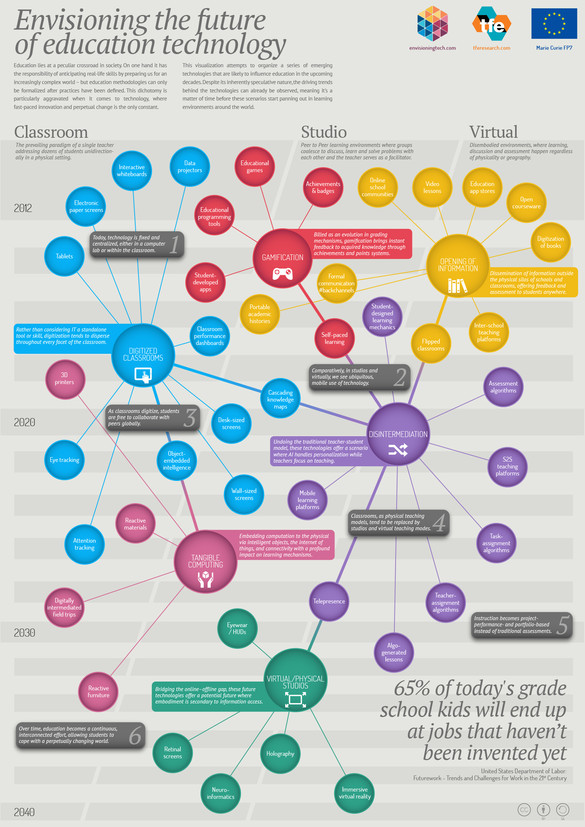
Mapping the Future of Educational Technology

If it’s true that 65% of today’s grade school students will work in jobs that don’t exist yet, then we better get ready for some drastically different learning environments.

Add this massive infographic to the recent discussion of futuristic dorms and what education will look like in 2020–and beyond. Designed by Michell Zappa’s Envisioning Technology (which also created that fantastic interactive infographic mapping the future of technology), this chart maps innovations in education technology for the next few decades.

It illustrates a shift from a classroom-centered approach toward an increasingly virtual set of learning environments. Of course the most eye-popping statistic is the idea that 65% of today’s grade-school children will end up at jobs that haven’t been invented yet. Hence the need for looking forward to try to anticipate how technologies might evolve and how we should expect to incorporate them into our schools.

“Despite its inherently speculative nature,” the graphic’s creators write, “the driving trends behind the technologies can already be observed, meaning it’s a matter of time before these scenarios start panning out in learning environments around the world.”

Links

E School News Top 10 Apps for Apple Devices

One app teaches young students about cyber bullying.

Last year we presented “10 of the best apps for education,” which highlighted some of the best apps for iPhones and iPods. However, with new upgrades in touch technology, HD and 3D features, and the debut of the iPad, we’ve come up with a new list of the best Apple-based education apps for 2012.

This year’s list includes some of the most highly rated apps, both by teachers and by Apple, and features a range that spans from simple math games to a revolutionary special-education app, and from 3D imaging of the elements included in the periodic table to secure file sharing for students and teachers.

For every app we’ve listed, we’ve included a brief description, device compatibility, suggested use, features, price, and a link to a more in-depth summary with an option to purchase on iTunes.

Don’t see an app you love on this list? Be sure to let us know—or leave a suggestion in the comment section.


Name: Edmodo

What is it? Edmodo makes it easy for teachers and students to stay connected and share information.

Best for: High school students; iPhone, iPod, iPad

Price: Free

Rated: 4+

Features: Send notes; submit assignments; post replies; check messages and upcoming events while away from the classroom; teachers can post last-minute alerts to their students, keep tabs on recent assignment submissions, and grade assignments; students can view and turn in assignments and check their latest grades.

Link: http://itunes.apple.com/us/app/edmodo/id378352300?mt=8

Name: Frog Dissection

What is it? This app is a greener alternative for teaching dissection in the classroom. It’s suitable for middle school students who are learning about organs and organ systems as part of their life science curriculum.

Best for: Science; Biology; iPad

Price: $3.99

Rated: 4+

Features: 3D imaging; step by step instructions with voice over; accurate simulation of the wet lab dissection procedure; content validation by subject matter experts; anatomical comparison of humans with frogs; comprehensive information on frogs’ organs; classification, lifecycle, and organ functions of frogs; interactive quiz on frogs; information on types of frogs.

Link: http://itunes.apple.com/us/app/frog-dissection/id377626675?mt=8

Name: Grammar Up HD

What is it? Improve grammar and vocabulary with this multiple-choice quiz system featuring more than 1,800 questions in 20 categories.

Best for: English/Language Arts; iPad

Price: $4.99

Rated: 4+

Features: More than 1,800 multiple-choice questions; choose number of questions you would like in each test; shows test results in HTML format; eMail yourself the test results and track your progress; “Progress Meter” keeps track of how you are performing in a particular topic; choose your own timer settings.

Link: http://itunes.apple.com/us/app/grammar-up-hd/id406782226?mt=8&ign-mpt=uo%3D4

Name: History: Maps of the World

What is it? Browse high-resolution maps of the world from various periods throughout history.

Best for: History, Geography; iPhone, iPod, iPad

Price: Free

Rated: 4+

Features: Wide variety of historical displays; support for Category/Era view; keyword search; displays the source about each map; zoom in/out (zoom in/out with pinch, zoom in with double tab, and zoom out with two-fingers tap); free screen rotation; does not require a network connection.

Link: http://itunes.apple.com/us/app/history-maps-of-world/id303282377?mt=8

Name: iStudiez Pro

What is it? Organize your class schedule, keep track of homework assignments, record your GPA, make to-do lists, and more with this app created for a busy student’s life.

Best for: High school students; iPhone, iPod, iPad

Price: $2.99

Rated: 4+

Features: Students are able to follow up with homework; summarizing schedules and assignments; tracking grades and GPA; push notifications; backup data options.

Link: http://itunes.apple.com/app/istudiez-pro/id310636441?ign-mpt=uo%3D4&mt=8

Name: Monster Anatomy

What is it? Explore 384 contiguous MR slices in the three anatomical planes with this interactive lower-limb radiology atlas.

Best for: Biology; iPhone, iPod, iPad

Price: $8.99

Rated: 4+

Features: Navigation with multiple shortcuts; display of images in the three anatomical planes; 3D image volume (VR) allows precise location of slice position; over 500 different labels in accordance with the “Terminologia Anatomica” and current literature references; more than 10,000 tags; the five different display modes available (bones, joints, muscles, blood vessels, and nerves) facilitate label visualization; high image quality with a zooming tool.

Link: http://itunes.apple.com/us/app/monster-anatomy-lower-limb/id358915264?mt=8&ign-mpt=uo%3D4

Name: Motion Math

What is it? Motion Math HD follows a star that has fallen from space and must bound back up, up, up to its home in the stars. Moving fractions to their correct place on the number line is the only way to return. By playing Motion Math, learners improve their ability to perceive and estimate fractions in multiple forms.

Best for: Math; iPhone, iPod Touch, iPad

Price: $1.99

Rated: 4+

Features: Problem hints; intro level, practice of improper fractions and negative decimals; beginner, medium, and expert modes; bonus levels.

Link: http://itunes.apple.com/us/app/motion-math/id392489333?mt=8

Name: Professor Garfield Cyberbullying

What is it? Teach kids anti-bullying messages and strategies for dealing with cyber bullies with the help of Garfield and friends.

Best for: Internet safety; elementary students; iPad

Price: Free

Rated: 4+

Features: Understand the meaning of cyber bully; learn to recognize different forms of cyber bullying; learn different strategies for dealing with a cyber bully; learn the importance of enlisting the help of a trusted adult when cyber bullied.

Link: http://itunes.apple.com/us/app/professor-garfield-cyberbullying/id369171501?mt=8

Name: Proloquo2go

What is it? This easy-to-use alternative communication solution offers an extensive library of symbols for those who have difficulty speaking. It provides natural sounding text-to-speech voices, high-res up-to-date symbols, automatic conjugations, a default vocabulary of more than 7,000 items, advanced word prediction, full expandability; and extreme ease of use. For anyone who cannot afford spending thousands of dollars on an AAC device and yet wants a solution that is just as good if not better. SLPs, teachers, and parents recommend it for children and adults with autism, cerebral palsy, down syndrome, developmental disabilities, apraxia, ALS, stroke, or traumatic brain injury.

Best for: Special education; iPhone, iPod, iPad

Price: $189.99

Rated: 4+

Features: Listed above; educational institutions can get a 50-percent discount on Proloquo2Go if they purchase 20 or more licenses through Apple’s Volume Licensing Program for Education.

Link: http://itunes.apple.com/app/proloquo2go/id308368164?ign-mpt=uo%3D4&mt=8

Name: The Elements: A Visual Exploration

What is it? Learn about the periodic table in a hands-on way. Choose any element—copper, for example—and see various copper objects: a Persian weave chain, a brass ring, a Chinese bronze … and then rotate them with your finger to get a 3D view.

Best for: Science; Chemistry; iPad

Price: $13.99

Rated: 4+

Features: Sharp HD images that can rotate (available in 3D); columns of facts and figures with each element; Wolfram Alpha computational knowledge engine.

Link: http://itunes.apple.com/us/app/elements-visual-exploration/id364147847?mt=8

Links

How to fix the charter school movement (and what Albert Shanker really said) let Jeff Piontek know….

Chris Cerf, the acting commissioner of education in New Jersey, published an article today defending charter schools, which have become very controversial in his state. They have become controversial because the state is trying to push them into suburbs that have great public schools and don’t want them, and they have become controversial because the public is beginning to revolt against for-profit charters, especially for-profit online charters, which Cerf is promoting.

People in New Jersey are beginning to realize that every dollar that goes to a privately managed charter school is a dollar taken away from
their own public school. Because the budget is not expanding, it IS a zero sum game. Fixed costs do not decline when children leave the school.

Despite Governor Chris Christie’s frequent belittling of New Jersey teachers and schools, New Jersey is one of the highest performing states in the nation on the federal National Assessment of Educational Progress. So, citizens of the state have good reason to oppose the Christie administration’s efforts to turn more taxpayer dollars over to private entrepreneurs.

In his article, Chris Cerf writes:


…it is often forgotten that one of the first advocates for public charter schools was Albert Shanker, the former New York City teachers’ union leader, who supported charter schools as a way to empower public school educators to innovate.


Chris Cerf needs to know what Albert Shanker really said about charter schools. This is what he would learn if he read pp. 122-124 of my book “The Death and Life of the Great American School System:”

1. Albert Shanker was president of the American Federation of Teachers, not the New York City union, when he first proposed the charter school idea in 1988.

2. Shanker proposed that any new charter should be jointly approved by the union and the school district. More than 90% of charters today are non-union. Shanker would not have approved any school that did not respect the rights of teachers to bargain collectively.

3. Shanker proposed that new charters should target the hardest-to-educate students: those who had dropped out or were failing. He never imagined that charters would have a selection process or that charters might avoid students with disabilities or English-language learners as is now the case in many charters.

3. Shanker wanted charters to collaborate, not compete, with existing public schools. He proposed them as a way to solve the problems of public schools. Whatever they learned, he said, should be shared with the public schools that sponsored them.

4. MOST IMPORTANT: In 1993, when Shanker saw that the charter idea was going to be used to privatize public education, he turned against charter schools. He opposed the takeover of the charter idea by corporations, entrepreneurs, and for-profit vendors. He became a vocal opponent of charter schools when he realized that his idea was embraced by “the education industry.” In his weekly column in The New York Times, Albert Shanker repeatedly denounced charter schools, vouchers, and for-profit management as “quick fixes that won’t fix anything.”

Here is an idea for Commissioner Cerf. You can fix the charter idea if you align it with Shanker’s original idea.

First, insist that all new charters are endorsed by the local school district and the union representing teachers.

Second, bar all for-profit management.

Third, insist that all charters recruit and enroll only the lowest-performing students, the students who have dropped out, and the students who are doing poorly in their present public school.

Fourth, require that charters collaborate with the public schools and share whatever they learn.

Fifth, to truly revive the spirit of Shanker’s proposal, bar all corporate-owned charter chains. Authorize only stand-alone charters that are created by teachers and parents in the district to serve the children of that district. No chains, just local charters committed to that community.

So, yes, Commissioner Cerf, you are on the right track when you quote Albert Shanker. Now, if you take his advice, you can save the charter school idea from the privatizers and profiteers who are giving it a bad name.