

38 ways Zoos and Aquariums are engaging people through Social Media

Interested in seeing- at a glance- which zoos and aquariums are using social media (or were by November 20, 2010 at least)? Check out this awesome spreadsheet created by  Anthony Brown of the San Francisco Zoo. It lists which zoos and aquariums are using Facebook, Twitter, Flickr, and YouTube, as well as basic engagement stats.

Check out some of the classic, creative, charming, and kooky ways that zoos and aquariums are using social technology to make waves in their communities and beyond:

Utilizing Basic Social Media Building Blocks.

1. Twitter. The Association of Zoos and Aquariums maintains a twitter list with over 127 accredited zoos and aquariums on Twitter. But from the looks of things, there are many, many more than that. Among hundreds of others, you can follow the Oregon Zoo, the California Academy of Sciences, the Seattle Aquarium, the Fort Worth Zoo, the Georgia Aquarium

2. Facebook. 7% of all humans are on Facebook and zoos and aquariums are effectively using this space to cultivate networks, create interaction, and share information. The Tennessee Aquarium always surprises me with cool facts in my Facebook news feed.

3. Flickr. Holy cow! If there’s one social media platform in which zoos and aquariums are taking the lead, it’s on Flickr. When asked (in a survey I crafted in collaboration with AZA), many zoos and aquariums reported Flickr initiatives as their most innovative uses of social technology. My favorite straight-up use of Flickr? That’s a toughie… but the Shedd Aquarium’s Flickr group is up there.

4. YouTube. There’s so much good stuff here, too. Zoos and Aquariums are mostly using this site to help them give visitors a behind-the-scenes look at the institution. I like the San Diego Zoo’s YouTube channel.

5. Website. Have you noticed that many of the biggest and most visited zoos and aquariums feature links to social media pages above the fold on their websites (even if it’s small)?

6. Interactive Pages. Many zoos and aquariums are putting their web-based social and educational resources in one place. Check out the New England Aquarium’s awesome interaction page.

7. Blogging. The Dickerson Park Zoo’s blog posts and short and sweet- and a lot of fun. Speaking of blogs, the Houston Zoo has four of them. They use fun facts and photos to share information on conservation, education and Trunk Tales, a blog covering elephant news and happenings at the zoo.

8. Mobile Applications. These ones by the Woodland Park Zoo, the Memphis Zoo, and the Dallas Zoo aim to make the visitor experience as comfortable as possible by providing basic information on the zoo and the exhibits. They even feature GPS so you can figure out how to get to your favorite animals.

9. Foursquare. Remember to check in when you visit the Sacramento Zoo. You’ll be rewarded with a free carousel ticket- and the mayor gets a free gift.

10. Virtual Conferences. The Association of Zoos and Aquariums is on top of creating engaging webinars that allow zoo and aquarium professionals to connect and share stories online. Couldn’t make it to the AZA Annual Conference in Houston? No worries.

11. Podcasts. The Aquarium of the Pacific’s (for instance) podcasts share information about the aquarium as well as news and information about issues facing our oceans and our planet. It’s music to an audible learner’s ears.

But that’s not even close to the end of it. Prepare to be inspired… and learn a thing or two about sea creatures, four-legged friends, the environment, and everything in between…

Storytelling and Online Engagement

12.  It’s a boy! This baby gorilla was abandoned by its mother, and then had to be raised by hand and trained with a surrogate mother at the San Fransisco Zoo.  The sensitive situation meant months of no on-site press. But it was no problem for the zoo. They captured the baby gorilla’s pertinent milestones on video. Everything was filmed and edited internally, uploaded on the Zoo’s YouTube channel and then distributed to the press. It worked beautifully and the press used these video links on their own Web sites and in print. Broadcasters pointed viewers and listeners to the YouTube channel and also aired them during newscasts.

13. Talk about streaming cuteness. The Knoxville Zoo’s creative partnership with the Mozilla Foundation raised awareness of endangered species through a 24 hour live stream of two red pandas (firefoxes). Their names, Ember and Spark, were determined by online voters. I cannot lie: sometimes I open this tab on my browser and check-in throughout the day. It’s that cute. (Please don’t judge…)

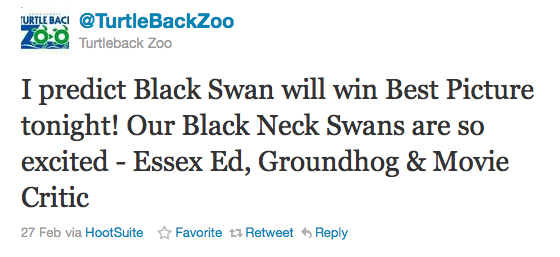
14. Meet Essex Ed. Turtle Back Zoo’s resident groundhog, Essex Ed, took over the Zoo’s twitter account during the month of February, expanding his prognostication prowess beyond winter weather predictions. Look out @SUEtheTrex & @NatHistoryWhale.This furry futurist was quite charming (even if his lovable predictions weren’t always correct).
15. Turning print materials into links. The National Aquarium transcends the divide between printed materials and the web by using QR codes on printed materials that link to their YouTube, Facebook, Twitter, or Flickr accounts.

16. Information share within the industry. Impactful nonprofits share their knowledge with others. That’s basically what the San Fransisco Zoo is doing in this video. One thing that I think is cool/important: the zoo doesn’t just leave twitter to the marketing department. They know that many departments should be at least a bit involved.

17. A picture’s worth a thousand words. The Monterey Bay Aquarium holds photo captions contests to engage visitors.

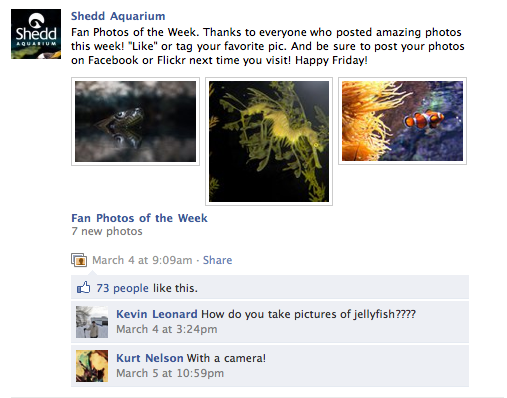
18. Going Meta. The Shedd Aquarium makes celebrating Flickr and Facebook fan engagement through Facebook look easy with their Fan Photo of the Week.  They encourage Facebook users to tag themselves in photos in order to vote for their favorite. It’s a genius voting system. When folks tag themselves to vote, it often shows up the newsfeed for people in their networks, spreading the initiative.
19. Live tweeting… from the ocean? The Birch Aquarium at Scripps took the middle-man out of education-based communication when they created a Twitter account specifically for whale-watching season. Their Naturalists tweet live from the boat!

20. Apes, Elephants, Pandas- oh my! The San Diego Zoo invites you to live stream their apes, elephants, pandas and polar bears! And while you’re on the site, try your hand at the Elephant Odyssey Game.

21. No photographer wants to be photo-bombed by strangers. The Aquarium of the Pacific takes Flickr photo contests to another level and uses it to bring folks in the door. They created regular Photography Nights in which photographers (and photographers-in-training) are welcome to take pictures without worrying about the general public.

22. Let’s tweetup! The Houston Zoo conducts so many of them that they have a separate Twitter account for them.

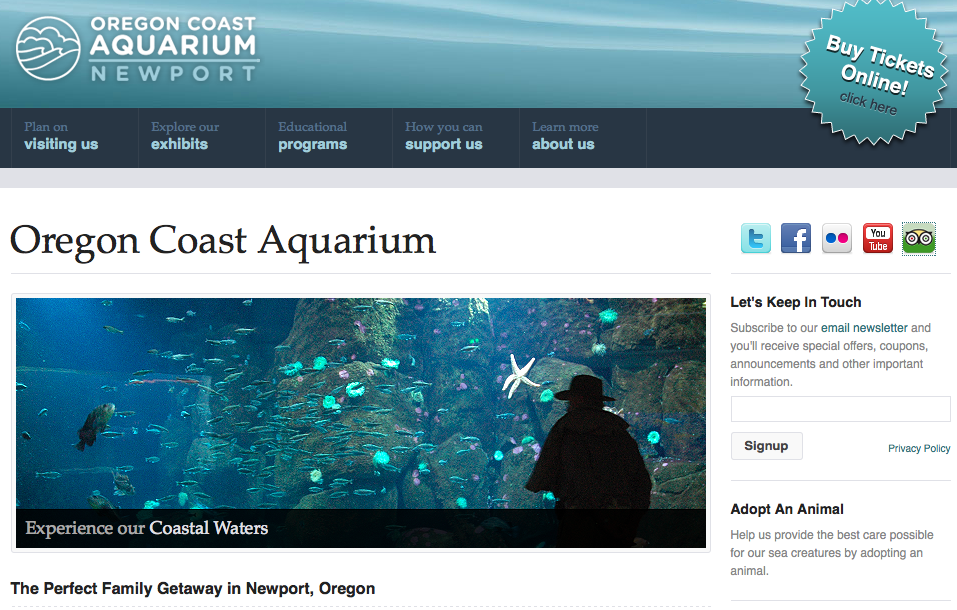
23. We advise you to visit the aquarium. Got a good rating on Trip Advisor thanks to great visitor service efforts? Flaunt it. Word of mouth marketing is thought be to the most trusted and effective form of marketing. Take a lesson from the Oregon Coast Aquarium: link to your ratings on Trip Advisor and make sure folks know how much your visitors love it.
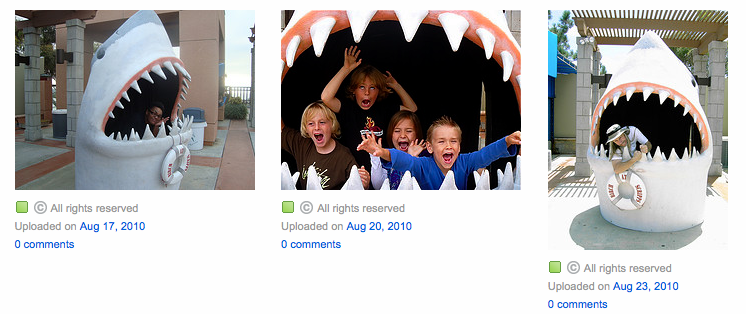
24. Know your assets! In this case, it’s a Great White Shark. Kind of. I dare you to take a look at this Flickr album of enthusiastic visitors to Birch Aquarium at Scripps, and tell me you don’t want to take a picture with this shark.
25. Because “Fluffy’s Daughter” is a bad name for a baby python. And the Columbus Zoo and Aquarium knew it was a lame name, so they called in help from their community. Their naming contest on Facebook resulted in thousands of submissions and 1,200 original names, which were narrowed to five and placed back on Facebook for voting.  Talk about well received; more than 500 people voted in the first 20 minutes and the zoo significantly boosted their “likes” on Facebook! (Spoiler: The name “Hanna” won with 816 votes)

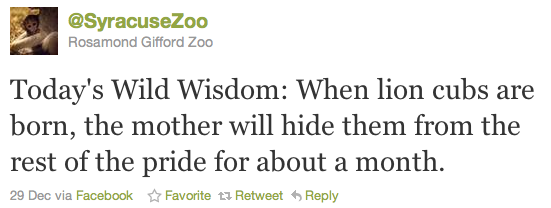
26. The good ole’ ‘Fun Fact’ route never goes out of style. Rosamond Gifford Zoo tweets healthy doses of “Today’s Wild Wisdom,” by popular demand from their online community. A little bit (more) proof that social media works best when educational or exciting information is shared… and not just used as an announcement board for holiday closures.

27. Calling all ‘Mommy Group Organizers!’ Using the social tool Meetup.com, the San Diego Zoo makes it easy to set up playdates at the zoo.

28. Are you on Jumo? The Palm Beach Zoo has a page. No pressure.

29. Cell phone audio guides are a classic. At the Florida Aquarium, kids can listen to birds, fish, alligators, and otters through a cell phone audio guide.

30. State lines are for dummies. The Columbus Zoo offers special distance learning classes to K-12 kids across the country. The program “brings the zoo to you” using standard audio/video teleconferencing equipment.

Fundraising, Working the Market, and Strategic Uses of Social Media

31. Mobile devices= tools for donations. The Cameron Park Zoo launched a mobile giving campaign, which allows guests to donate $5 or $10 via text message. .

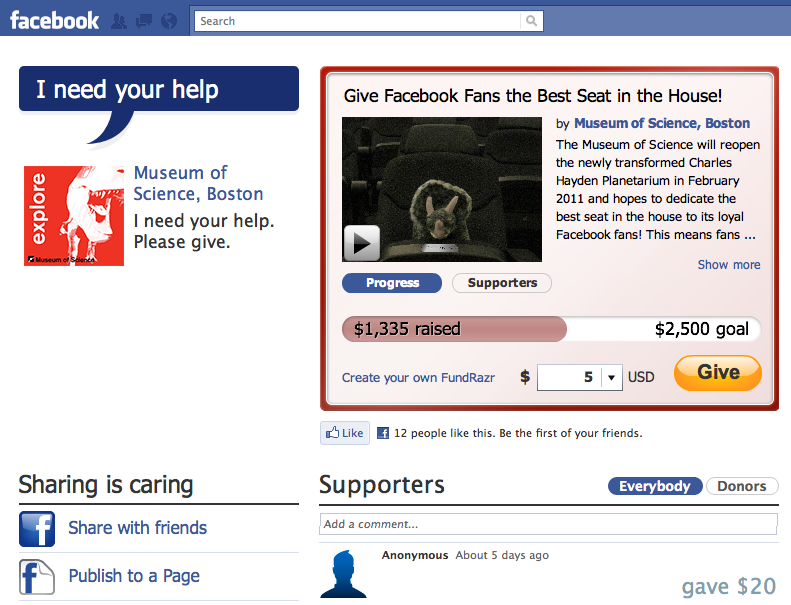
32. Making fundraising social with new tools. The Museum of Science in Boston uses Fundrazr, a social fundraising tool, to raise funds. In fact, the museum has raised over $2500 for the renovation of the Charles Hayden Planetarium exclusively through its network of online followers.
33. Meet the parents. The Knoxville Zoo knows who makes up a big part of their market- and they utilize a local online social resource called knoxmoms.com to connect with parents in the area.

34. Zoos vs. Aquariums: Who does it better? The National Mississippi River Museum and Aquarium is already rocking the contests tab on their Facebook page to engage audiences- but one of their greatest contests featured a friendly race that pitted them against the Blank Park Zoo in Des Moines, IA. The race was to see which one–Aquarium or Zoo–could promote their page in order to get the most new likes/fans for their respective Facebook page by the end of the contest on October 31, 2010.  It was close, but in the end, the aquarium lost and had to do a full day of “dirty jobs” for the zoo.  But both organizations were winners in the end because of the increase in fans resulting from the competition.  The Aquarium increased it’s Facebook fan base by 283%!
35. A collaboration to strengthen community. The Cheyenne Mountain Zoo partnered with the Division 1 college hockey team in town, the Tigers, to promote both partners’ community-strengthening missions. They agreed to publicize for one another through their social media channels. In exchange, the Tigers promoted the zoo by showing video footage of the zoo’s tigers during period breaks, on the concourse, and on TV big screens at games. The zoo and the hockey team also conducted a successful meet-and-greet with players at the zoo, all the while shouting out to one another and publicizing these events through social media.

36. Make it easier for fans to give. In celebration of National Adoption Day, the Rosamond Gifford Zoo did a two-day promotion in which they significantly discounted their Adopt-an-Animal program. They created a custom package that was smaller than a traditional package (and therefore less expensive for us to produce). The result? An easy way to make an additional $350 for the program while getting the word out and giving their online community a sense of special perks.

37. Don’t forget gift shop sales! Folks at  Clyde Peelings Reptiland say that Facebook is their favorite way to  promote new items in their gift shop.

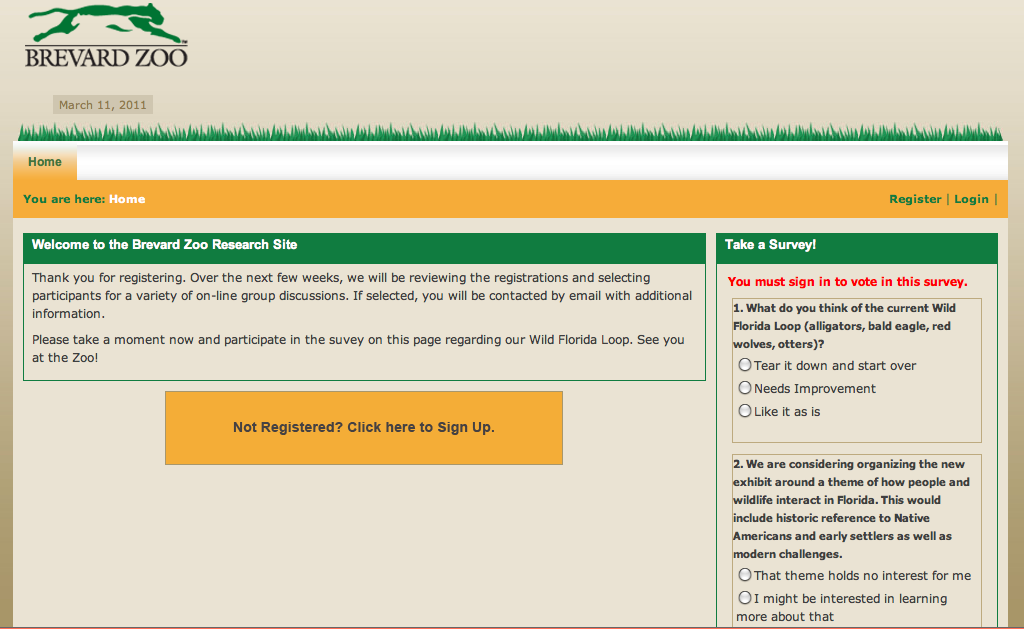
38. Tapping social technology for active feedback. The first step in evolving in order to best need visitor needs is to know what those needs are. By listening to audiences on social media, organizations can learn a lot about those needs- but the Brevard Zoo is taking an even more direct approach. They created research site that asks visitors how the museum can improve. The site allows them to get active feedback, create focus groups, and engage in private forums.
Do you know of any zoos and aquariums utilizing social technology to engage audiences in ways that aren’t mentioned here? Share them in the comments section and add them to the list!

The Disturbing Transformation of Kindergarten

nclbOne of the most distressing characteristics of education reformers is that they are hyper-focused on how students perform, but they ignore how students learn. Nowhere is this misplaced emphasis more apparent, and more damaging, than in kindergarten.

A new University of Virginia study found that kindergarten changed in disturbing ways from 1999-2006. There was a marked decline in exposure to social studies, science, music, art and physical education and an increased emphasis on reading instruction. Teachers reported spending as much time on reading as all other subjects combined.

The time spent in child-selected activity dropped by more than one-third. Direct instruction and testing increased. Moreover, more teachers reported holding all children to the same standard.

How can teachers hold all children to the same standards when they are not all the same? They learn differently, mature at different stages – they just are not all the same especially at the age of 4-6.

Is this drastic shift in kindergarten the result of a transformation in the way children learn? No! A 2011 nationwide study by the Gesell Institute for Child Development found that the ages at which children reach developmental milestones have not changed in 100 years.

For example, the average child cannot perceive an oblique line in a triangle until age 5 ½. This skill is a prerequisite to recognizing, understanding and writing certain letters. The key to understanding concepts such as subtraction and addition is “number conservation.” A child may be able to count five objects separately but not understand that together they make the number five. The average child does not conserve enough numbers to understand subtraction and addition until 5½ or 6.

If we teach reading, writing, subtraction and addition before children are ready, they might memorize these skills, but will they will not learn or understand them. And it will not help their achievement later on.

Illinois kindergartenChild development experts understand that children must learn what their brains are ready to absorb. Kindergarten is supposed to set the stage for learning academic content when they are older. If they are going to push our kindergarten children to move faster, what does that say for the push for “educating” Pre-K?

Play is essential in kindergarten – in fact in any child under the age of 5. Through play, children build literacy skills they need to be successful readers. By speaking to each other in socio-dramatic play, children use the language they heard adults read to them or say. This process enables children to find the meaning in those words.

There is a wide range of acceptable developmental levels in kindergarten; so a fluid classroom enables teachers to observe where each child is and adjust the curriculum accordingly.

Two major studies confirmed the value of play vs. teaching reading skills to young children. Both compared children who learned to read at 5 with those who learned at 7 and spent their early years in play-based activities. Those who read at 5 had no advantage. Those who learned to read later had better comprehension by age 11, because their early play experiences improved their language development.

Yet current educational policy banishes play in favor of direct instruction of inappropriate academic content and testing; practices that are ineffective for young children.

The No Child Left Behind Law played a major role in changing kindergarten. Upper-grade curricula were pushed down in a mistaken belief that by learning reading skills earlier, children would fare better on standardized tests. Subjects not tested by NCLB were de-emphasized. Lawmakers insisted that standardized tests assess reading at earlier ages, even though standardized tests are invalid for children under 8.

ccs I cantThese changes have the harshest effect on our most vulnerable children. The UVA study found that in schools with the highest percentage of children of color and children eligible for free-and-reduced-priced lunch, teachers had the most demanding expectations for student performance.

To make matters worse, the drafters of the Common Core ignored the research on child development. In 2010, 500 child development experts warned the drafters that the standards called for exactly the kind of damaging practices that inhibit learning: direct instruction, inappropriate academic content and testing.

These warnings went unheeded.

Consequently, the Common Core exacerbates the developmentally inappropriate practices on the rise since NCLB. Teachers report having to post the standards in the room before every scripted lesson, as if 5-year-olds can read or care what they say. They time children adding and subtracting, and train them to ask formulaic questions about an “author’s message.” All children are trained in the exact same skill at the same time. One teacher lamented that “there is no more time for play.” Another wrote “these so-called educational leaders have no idea how children learn.”

It may satisfy politicians to see children perform inappropriately difficult tasks like trained circus animals. However, if we want our youngest to actually learn, we will demand the return of developmentally appropriate kindergarten.

Happy Valentines Day “To fall in love with anyone do this


More than 20 years ago, the psychologist Arthur Aron succeeded in making two strangers fall in love in his laboratory. Last summer, I applied his technique in my own life, which is how I found myself standing on a bridge at midnight, staring into a man’s eyes for exactly four minutes.

Let me explain. Earlier in the evening, that man had said: “I suspect, given a few commonalities, you could fall in love with anyone. If so, how do you choose someone?”

He was a university acquaintance I occasionally ran into at the climbing gym and had thought, “What if?” I had gotten a glimpse into his days on Instagram. But this was the first time we had hung out one-on-one.

“Actually, psychologists have tried making people fall in love,” I said, remembering Dr. Aron’s study. “It’s fascinating. I’ve always wanted to try it.”

I first read about the study when I was in the midst of a breakup. Each time I thought of leaving, my heart overruled my brain. I felt stuck. So, like a good academic, I turned to science, hoping there was a way to love smarter.

I explained the study to my university acquaintance. A heterosexual man and woman enter the lab through separate doors. They sit face to face and answer a series of increasingly personal questions. Then they stare silently into each other’s eyes for four minutes. The most tantalizing detail: Six months later, two participants were married. They invited the entire lab to the ceremony.

“Let’s try it,” he said.

Let me acknowledge the ways our experiment already fails to line up with the study. First, we were in a bar, not a lab. Second, we weren’t strangers. Not only that, but I see now that one neither suggests nor agrees to try an experiment designed to create romantic love if one isn’t open to this happening.

I Googled Dr. Aron’s questions; there are 36. We spent the next two hours passing my iPhone across the table, alternately posing each question.

They began innocuously: “Would you like to be famous? In what way?” And “When did you last sing to yourself? To someone else?”

But they quickly became probing.

In response to the prompt, “Name three things you and your partner appear to have in common,” he looked at me and said, “I think we’re both interested in each other.”

I grinned and gulped my beer as he listed two more commonalities I then promptly forgot. We exchanged stories about the last time we each cried, and confessed the one thing we’d like to ask a fortuneteller. We explained our relationships with our mothers.

The questions reminded me of the infamous boiling frog experiment in which the frog doesn’t feel the water getting hotter until it’s too late. With us, because the level of vulnerability increased gradually, I didn’t notice we had entered intimate territory until we were already there, a process that can typically take weeks or months.

I liked learning about myself through my answers, but I liked learning things about him even more. The bar, which was empty when we arrived, had filled up by the time we paused for a bathroom break.
Continue reading the main story

I sat alone at our table, aware of my surroundings for the first time in an hour, and wondered if anyone had been listening to our conversation. If they had, I hadn’t noticed. And I didn’t notice as the crowd thinned and the night got late.

We all have a narrative of ourselves that we offer up to strangers and acquaintances, but Dr. Aron’s questions make it impossible to rely on that narrative. Ours was the kind of accelerated intimacy I remembered from summer camp, staying up all night with a new friend, exchanging the details of our short lives. At 13, away from home for the first time, it felt natural to get to know someone quickly. But rarely does adult life present us with such circumstances.

The moments I found most uncomfortable were not when I had to make confessions about myself, but had to venture opinions about my partner. For example: “Alternate sharing something you consider a positive characteristic of your partner, a total of five items” (Question 22), and “Tell your partner what you like about them; be very honest this time saying things you might not say to someone you’ve just met”

Much of Dr. Aron’s research focuses on creating interpersonal closeness. In particular, several studies investigate the ways we incorporate others into our sense of self. It’s easy to see how the questions encourage what they call “self-expansion.” Saying things like, “I like your voice, your taste in beer, the way all your friends seem to admire you,” makes certain positive qualities belonging to one person explicitly valuable to the other.

It’s astounding, really, to hear what someone admires in you. I don’t know why we don’t go around thoughtfully complimenting one another all the time.

We finished at midnight, taking far longer than the 90 minutes for the original study. Looking around the bar, I felt as if I had just woken up. “That wasn’t so bad,” I said. “Definitely less uncomfortable than the staring into each other’s eyes part would be.”

He hesitated and asked. “Do you think we should do that, too?”

“Here?” I looked around the bar. It seemed too weird, too public.

“We could stand on the bridge,” he said, turning toward the window.

The night was warm and I was wide-awake. We walked to the highest point, then turned to face each other. I fumbled with my phone as I set the timer.

“O.K.,” I said, inhaling sharply.

“O.K.,” he said, smiling.

I’ve skied steep slopes and hung from a rock face by a short length of rope, but staring into someone’s eyes for four silent minutes was one of the more thrilling and terrifying experiences of my life. I spent the first couple of minutes just trying to breathe properly. There was a lot of nervous smiling until, eventually, we settled in.

I know the eyes are the windows to the soul or whatever, but the real crux of the moment was not just that I was really seeing someone, but that I was seeing someone really seeing me. Once I embraced the terror of this realization and gave it time to subside, I arrived somewhere unexpected.

I felt brave, and in a state of wonder. Part of that wonder was at my own vulnerability and part was the weird kind of wonder you get from saying a word over and over until it loses its meaning and becomes what it actually is: an assemblage of sounds.

So it was with the eye, which is not a window to anything but rather a clump of very useful cells. The sentiment associated with the eye fell away and I was struck by its astounding biological reality: the spherical nature of the eyeball, the visible musculature of the iris and the smooth wet glass of the cornea. It was strange and exquisite.

When the timer buzzed, I was surprised — and a little relieved. But I also felt a sense of loss. Already I was beginning to see our evening through the surreal and unreliable lens of retrospect.

Most of us think about love as something that happens to us. We fall. We get crushed.

But what I like about this study is how it assumes that love is an action. It assumes that what matters to my partner matters to me because we have at least three things in common, because we have close relationships with our mothers, and because he let me look at him.

I wondered what would come of our interaction. If nothing else, I thought it would make a good story. But I see now that the story isn’t about us; it’s about what it means to bother to know someone, which is really a story about what it means to be known.

It’s true you can’t choose who loves you, although I’ve spent years hoping otherwise, and you can’t create romantic feelings based on convenience alone. Science tells us biology matters; our pheromones and hormones do a lot of work behind the scenes.

But despite all this, I’ve begun to think love is a more pliable thing than we make it out to be. Arthur Aron’s study taught me that it’s possible — simple, even — to generate trust and intimacy, the feelings love needs to thrive.

You’re probably wondering if he and I fell in love. Well, we did. Although it’s hard to credit the study entirely (it may have happened anyway), the study did give us a way into a relationship that feels deliberate. We spent weeks in the intimate space we created that night, waiting to see what it could become.

Love didn’t happen to us. We’re in love because we each made the choice to be.


Modern Love

By MANDY LEN CATRON

14
Feb 2015
POSTED BY Jeff
POSTED IN

Articles

DISCUSSION No Comments

6 links that will show you what Google knows about you


Want to find out all the things Google knows about you? Here are 6 links that will show you some of the data Google has about you.

1. Find out what Google thinks about you

In order to serve relevant ads, Google collects data about you and creates a profile. You can control and review the information Google has on you here:

http://www.google.com/settings/ads/

Google also has a tool called Google Analytics, that helps publishers see what pages you have viewed on their website, how many times you have visited it, how long did you stay etc. You can opt out if you don’t want this type of data to be collected:

http://tools.google.com/dlpage/gaoptout

2. Find out your location history

If you use Android, your mobile device may be sending your location to Google. You can see your entire location history here:

https://maps.google.com/locationhistory

3. Find out your entire Google Search history

Google saves every single search you have ever done. On top of that, they record every Google ad you have clicked on. This log is available in Google web history controls:

https://www.google.com/history/

4. Get a monthly security and privacy report from Google

Google offers an Account activity page that tells you about all the Google services you are using. You can even enable a monthly report that will be sent to your email:

https://www.google.com/settings/dashboard

5. Find out all the apps and extensions that are accessing your Google data

The Account activity page also offers a list of all the apps that have any type of access to your data. You can see the exact type of permissions granted to the app and revoke access to your data here:

https://security.google.com/settings/security/permissions

6. Export all of your data out of Google

Google lets you export all your data: bookmarks, emails, contacts, drive files, profile info, your youtube videos, photos and more here:

https://www.google.com/takeout

BONUS

Google also keeps a history of your YouTube searches. You can find it here:

https://www.youtube.com/feed/history/search_history

09
Feb 2015
POSTED BY Jeff
POSTED IN

Articles

DISCUSSION No Comments

10 Secret Sites Of New York City

Whether you’re an adventurous New Yorker or a tourist looking to make a few unconventional stops, consider paying a visit to some of the city’s little-known gems.

Dead Horse Bay

Joanna Jeros / Via Instagram: @voodoohex

What it is: A horse-rendering plant turned landfill turned wonderland of amazing treasures (read: other people’s trash and the occasional horse bone) from the past century. From the 1850s through 1930s, it served as a site where the bodies of dead horses and other animals were used to make glue, fertilizer, and more. It then became a dumping grounds for the city’s trash, and since the 1950s, New York’s garbage has continued to wash up along the shore.

Why you should visit: You’ll find old bottles — from sodas to perfume vials to condiment jars — from generations past, as well horse (and other animal) bones, disintegrated toys, scraps of metal, glass, plastic, and more. It’s both a fascinating and slightly chilling atmosphere that’ll have you sifting through recognizable relics and unidentifiable objects with just the sound of the waves crashing against another era’s trash as your soundtrack. (Be sure to wear sturdy shoes and bring gloves.)

Accessibility: Take the 2 or 5 train to Flatbush Ave./Brooklyn College to the Q35 bus — then walk through a trail to the beach. (Watch out for poison ivy on the way in!)

2. North Brother Island

North Brother Island

Delaywaves /__username__ / Via en.wikipedia.org

What it is: An island in the East River, between the Bronx and Rikers Island, with a murky history. Once the site of Riverside Hospital, which treated smallpox, tuberculosis, and other quarantinable diseases, North Brother Island was also the home of Typhoid Mary, who was confined there for the last two decades of her life until she died in 1938. In the 1950s, a center opened to treat adolescent drug addicts, some of whom were said to be held there against their will. (Also, in 1904, a steamship called the General Slocum burned on North Brother Island, killing over 1,000 people.)

Why you should visit: Now the island is a bird sanctuary, and ruins of the hospital and other buildings remain, with some rooms amazingly pretty intact. (Check out awe-inspiring photos of a visit to the island here.) There’s probably asbestos permeating the air, but the element of danger paired with the creepy abandoned-island vibe should be enough incentive for you to start planning your yolo-ified voyage here — though you’ll probably have to get creative. (See “Accessibility.”)

Accessibility: Welp…it’s sort of impossible. It’s off-limits to the public, and you have to obtain a permit from the city and charter a boat to get there, which can be pricey. Also, there’s no dock. Oh, and you can only visit between November and February (the herons nest during the rest of the year). AKA get yourself psyched for a freezing cold, perilous, and likely illegal trip to the coolest island on NYC!

3. South Brother Island

South Brother Island

Courtesy of NYC Audubon / Via tpl.org

What it is: North Brother Island’s smaller counterpart. The 7-acre island was once the summer home to a former owner of the Yankees, Jacob Ruppert, but since 1909 (when his home burned down), it’s been uninhabited by humans. In 2007, New York City bought the island and turned it into a bird sanctuary.

Why you should visit: The island is now home to several bird species, including the black-crowned night heron, great egret, snowy egret, and double-crested cormorant.

Accessibility: It’s off-limits to the public except for a few days a year, when environmental groups are granted permission to clean the island. (If you were thinking about volunteering, here’s a good excuse!)

4. Hart Island

Hart Island

Marie Lorenz / Via tideandcurrenttaxi.org

What it is: The largest publicly funded cemetery in the world, with approximately 850,000 bodies buried here. Hart Island is located just east of City Island, and is technically considered part of the Bronx. It once served as a prisoner of war camp and also housed a prison and women’s asylum. Burials here began taking place during the American Civil War — and these days, since the island is operated by the Department of Corrections, mass burials are carried out by Rikers Island inmates. Those buried on Hart Island could either not afford the expenses of private funerals or were unclaimed by relatives; approximately 50% of the bodies buried here are children under 5 who are identified and died in NYC hospitals.

Why you should visit: These photos, of what remains of the buildings (including a Catholic chapel) on the island, should be enough to allure you. Also, if you believe you may have family buried here, bodies in unmarked coffins have been disinterred at the request of relatives.

Accessibility: The island is open to the public, and limited access is provided to those who would like to honor the memory of those buried here. You can find more information about visiting here, where you’ll also find a database of who is buried on the island. There are over 65,000 names in the registry, dating back to 1977 (a fire on the island destroyed records prior to this), and more names are planned to be added as they become available. Nonprofit The Hart Project has been working to help people around the world relocate those who disappeared in the greater New York area.

5. Kings Park Psychiatric Center

Kings Park Psychiatric Center

John Bencina /__username__ / Via Flickr: 85982060@N00

What it is: An abandoned psychiatric hospital in Long Island that treated hundreds of thousands of patients from 1885 through 1996. After it closed, the grounds became a state park, as The New York Times says, “partly because nobody knew what else to do with it. Too far from major roads and full of buildings contaminated with asbestos and lead, it has proved inhospitable to redevelopment.”

Why you should visit: The center is rumored to be awash in paranormal activity. (A 2007 slasher film called Blood Night: The Legend of Mary Hatchet is based on the urban legend of a girl who was supposedly committed to the center after killing her family and whose ghost haunts the grounds.)

Accessibility: W. 4th Street, Kings Park, NY 11754; OK, so technically, this one’s in Long Island — but it’s just a Long Island Rail Road trip away, to Kings Park station. The old hospital is now part of Kings Park, and you’d need to obtain a permit and clear your visit with the parks manager to visit legally. Periodically, though, there are walking tours here; in the past, they’ve been given by an organization called Angels Without Faces.

6. Community 54

Community 54

What it is: A cool vintage store hidden behind a sort of cruddy-looking arcade room; you enter through a photo booth. There’s also a graffitied courtyard in the back.

Why you should visit: If you’re into vintage duds with a streetwear vibe — and OK with dropping a few bills for said items — or if you’re looking to host a private event in the courtyard. Find out about events and check out photo booth pics on their site.

Accessibility: 54 Clinton Street, New York, NY 10002; take the J/M/Z/F trains to Delancey/Essex.

7. Tugboat Graveyard

Tugboat Graveyard

Jorge Quinteros /__username__ / Via Flickr: jorgeq82

What it is: The final resting place of rotting tugboats and other vessels dating back to the early 20th century; you’ll find it in the Arthur Kill waterway, between Staten Island and New Jersey.

Why you should visit: Though just about two dozen decomposing ships remain (down from approximately 200 in 1990) here, it’s still a cool spot for anyone who digs nautical history — and a fantastic place for a photo shoot.

Accessibility: 2453 Arthur Kill Road, Staten Island, NY 10309; take the Staten Island Ferry to the Staten Island Rapid Transit Train to Pleasant Plains to a 45-minute walk. Or, you know, you can drive there.

8. Jamaica Bay Riding Academy

Jamaica Bay Riding Academy

What it is: According to its website, Jamaica Bay Riding Academy is “a full-service boarding facility and additionally offers a vast variety of trail rides, horseback riding lessons, horse leasing, horse shows, summer camps, therapeutic riding, hunter paces, and more.”

Why you should visit: Horses! Learn to ride horses! The park on which the academy is located includes over 400 acres of wooded trails and 3 miles of beach-front riding. Plus, there’s a summer camp available for kids 5 through 15, you can host parties here, and there’s a full tack and apparel shop on the grounds.

Accessibility: 7000 Shore Parkway, Brooklyn, NY 11234; take the L train to the Rockaway Parkway/Canarsie stop to the B42 bus to a 40-minute walk. (Or cab/drive it.)

9. Roosevelt Island

Roosevelt Island

acidpolly /__username__ / Via Flickr: 59298735@N00

What it is: Technically a part of the borough of Manhattan, this island sits just between the Upper East Side and Queens. OK, OK, I KNOW, it’s not so much a secret — it’s just that no one ever goes to Roosevelt Island except the people who live there. But you should! There’s lots of fun stuff going on here that you probably don’t know about.

Why you should visit: There are outdoor movie nights at Southpoint Park (next up: Rocky on Aug. 10), rides on the tram, the Northpoint Lighthouse (a Gothic-revival lighthouse built in 1872 to provide light for a nearby insane asylum that is no longer), the RIVAA art gallery (with very 9-to-5er-friendly hours), and a historic church.

Accessibility: The F train to the Roosevelt Island stop.

10. Night Heron

Night Heron

Benjamin Norman/The New York Times/__username__

What it is: An invitation-only illegal nightclub held in a Chelsea water tower. It ran for eight weekends from March through May.

Why you should visit: It’s over now, so you can’t. Womp womp. But the Heron’s architect, N.D. Austin, is known for what he calls “trespass theater.” Who knows if a similar project may be in the works sometime in the near future?

Accessibility: Getting in required you be handed a pocket watch by a prior guest, reported to a street corner at a certain time, and called a number found inside the watch for location details.

Good Enough” TV Shows to Fill the Gap Between Preschoolers and Pre-Teens

 http://www.sunshineandhurricanes.com/wp-content/uploads/2014/05/preschool-to-preteen-TV-text.jpg

Ahhh summertime, if only it was as ideal in reality as it is in our imaginations (or other people’s blog posts).  I guarantee we get plenty of family together time and my kids are just the right combination of active, entertained and bored. We play games, read books, frolic in the pool, host play dates, ride bikes, draw chalk on the sidewalk, build amazing lego structures, blow bubbles, but all of that rarely gets us past lunchtime. Plus, we live in Florida where it is either storming or almost 100 degrees most afternoons.

So, I will confess what most other moms may not want to, I ACTUALLY LET MY KIDS WATCH TV!!! Alright, those of you keeping the mommy wars alive, feel free to jump directly to the comments at this point. The rest of you, let’s move on shall we.  I really don’t have any guilt about letting my kids watch TV a couple of hours a day during the summer, but I do struggle with WHAT they are watching.

I don’t know about you, but when my now almost 10 year old son starting outgrowing the shows on Disney Jr and NickJr around five or six, I wasn’t ready to embrace the next set of dominant programming available. It felt like there was nothing in between Dora& Diego and Dating.  Plus, I couldn’t help wondering why all the parents on those “tween” shows were either absent or idiots? (Let’s just leave Max and Ruby out of this so things don’t get confusing). So, I began looking for appropriate entertainment that I knew he would find engaging, while not pushing him into territory that I didn’t think he was ready for and that I KNEW I wasn’t ready for.

Here’s a list of the options I found (some you might remember from your own childhood) that were a hit with him and gave me a few more years to keep tweendom at bay.  I realize these are not ALL A + programming and even have some limited violence. However, most are intelligently written, have moral lessons in them and when there is minimal violence it’s in the context of real fantasy and make believe. We all know TV isn’t perfect, but for most of us it is a part of life and we can at least feel like we’re being active in providing good enough choices on this front.

Here is a list of shows by network or other available distribution.  Many are available for free via Amazon Prime , I can’t tell you how much we’ve found the investment more than worth the yearly membership fee for our family. For those shows on network/cable television, if you have cable most can be found On Demand for free provided they are a part of your subscription package. We also have a DVR and we will set recordings for numerous episodes and then I just have them available as needed. A few of the networks do have commercials during the shows, so this way we can skip over those unwanted marketing messages.

“Good Enough” TV Viewing Choices for Preschoolers to Pre-teens:


1.  Inspector Gadget (Amazon Prime)


2. The Last Airbender and The Legend of Korra  (Nickelodeon and Amazon Prime)


3. Teenage Mutant Ninja Turtles (Nickelodeon)

4. Animaniacs (Amazon Prime)


5. Pokemon (Cartoon Network)


7. Star Wars – The Clone Wars and/or the Yoda Chronicles (Cartoon Network)


8. Ninjago (Cartoon Network)


9. Win, Lose or Draw and Family Game Night (Disney)


10. Slugterra (Disney XD)


11. Phineas and Ferb (Disney XD)


12. Scooby Doo (Cartoon Network) 


13. The Penguins of Madagascar (Amazon Prime and Nickelodeon) 

14. Gilligan’s Island (TV Land) 


15. Mr. Peabody and Sherman (Amazon Prime) 


16. The Brady Bunch (CBS.com)


17. Full House (Nick and TBS)


18. Tom & Jerry (The Cartoon Network)


19. Dreamworks Dragons (The Cartoon Network)


11 Things That Are Supposed To Happen On Real Dates That Don’t Anymore

I don’t like dating. Mostly because no one seems to understand what dating is supposed to be anymore. These days, what gets labeled as a “date” is really just an unnecessarily extravagant booty call.

Listen, there is nothing at all wrong with just having sex. I’m all for it. But if you’re going to date, then actually date.

You should be capable of differentiating the two and approaching the two different scenarios differently. The problem is that most of us are so used to pseudo-dating in order to get off that when we find ourselves on what ought to be an actual date, we don’t know how to act.

If you’re going on a date, treat it like an actual date. If you don’t remember what that looks like anymore — and I can’t blame you for that — here are a few things that are supposed to happen:

1. Prior to the date, you’re supposed to feel nervous — especially if it’s a first date.

If you don’t feel nervous, then you’re not excited about the date. And if you’re not excited about the date, then why in the world are you going on the date in the first place? People these days date for the sake of dating.

We don’t go on dates because we find someone who truly catches our interest, but we go on dates because it’s an activity that fills some time — and possibly gets us laid.

If you’re really that bored, I’m sure you can find more productive things to do than force something that you already have little to no interest in.


2. You’re supposed to spend too much time getting ready.

I have a theory on why relationships fail. In their simplest form, I believe that they fail because both partners stop trying to impress the other.

We get too comfortable and feel that going that extra mile has no value. We already have our prize, so why continue pursuing it?

This is something that you should remember: You can always lose the person you love. Just because you have them now doesn’t mean that you’ll have them tomorrow.

You should impress them every chance you get because you love them and believe they deserve to be impressed. If this is your first date together and you feel no urge to put in a little extra effort, then I can tell you right now that it won’t go anywhere.


3. “Pick you up at your place at 7?”

That’s right — guys used to pick girls up and then go to dinner together. I’m sure that most of the men reading this don’t even remember the last time they picked a girl up and then went to dinner together.

Such a sight is surely more common in suburban and more rural areas, but in urban settings, it’s basically nonexistent.

Just because you don’t have a car doesn’t mean you shouldn’t pick her up from her apartment. Why? For one, it’s a nice and gentlemanly thing to do and she’ll appreciate it (which should be enough).

Two, you should want to squeeze in as much time with her as possible. Picking her up before dinner will get you at least an extra 30 minutes.


4. Whatever happened to flowers?

Yeah, yeah… save the planet. I’m certain that that isn’t the reason no guy has ever given you flowers on a date. For starters, it’s probably because he doesn’t pick you up and then take you to dinner (bringing flowers to the restaurant is a bit awkward and inconvenient).

But at the end of the day, it’s because he either feels like it’s too cheesy — thank you modern-day dating culture — or he doesn’t care about you enough to put in that extra effort.

Women love flowers. And if your woman happens not to, bring her chocolates instead. If she doesn’t like either, then find another woman — you’re dating the devil. (Kidding.)


5. Dinner, not coffee, not drinks, not “watching a movie at his place.”

Not going to see a movie at the movie theater, either. In case you’ve forgotten, the point of going on a date is to get to know the person. The best setting is over dinner.

You have plenty of time to talk, plus you get breaks during courses, allowing you to smooth out the awkwardness that almost always exists on first dates.

Coffee and/or drinks sends the wrong message. Coffee either means, “I just want to be friends” or “I don’t have the balls to ask you out to dinner.” And drinks… well drinks mean that you just want to get laid.


6. You’re supposed to have stimulating conversations.

Of course, not all dates will lead to stimulating conversations, but if you’re dating the right person, they will.

The right person for you is the person that you find it incredibly easy to talk to, the person you feel so comfortable with that you aren’t watching every word you say to make sure you don’t say something they’ll find inappropriate.

If you find yourself constantly making sure you aren’t stepping on his or her toes, or you spend an entire evening talking about the weather and them Yankees, take it as a sign that that should be your first and last date with that individual.


7. You’re supposed to drink in moderation.

I don’t believe that drinking on dates, even first dates, is a bad thing. It’ll help loosen you up and make you feel more relaxed — good things. Of course, many of us aren’t especially good at drinking in moderation.

Before you know it, you’re six drinks in and beginning to slur your words. I feel that the more “official” the date is, the more people watch how much they drink.

However, chances are that if you aren’t really on the date in order to date the person, but just there to hopefully get a little action after dinner, you’re going to get pretty smashed.

I mean, how else are you going to convince yourself — and her — that it’s a good idea for the two of you — two people who don’t even know each other — to have sex? Bottoms up.


8. The guy is supposed to pick up the tab.

Yes, you read that right. Of course, not every single time. In fact, I’d say that the guy should only pick up the tab on the first date.

After that, assuming both people can afford to pay for dinner, the bill should be put on rotation. But on the first date the guy should cover the tab. Why? Because guys take girls out on dates to treat them.

It shows that you care about her and that you’re capable of being selfless. Unfortunately, there are many women out there — you know who you are — that take advantage of this.

If you’re a guy and find yourself paying for dinner every single time, I hope you’re at least getting laid. If you’re not then, I’m sorry, but you’re a schmuck. If she’s using you, you should be returning the favor.


9. He’s also supposed to walk you — or take you — home.

It’s the gentlemanly thing to do. Dating is the result of romantic love making its way into human culture. It exists, and only exists, because we believe romantic love to be a thing.

For romantic love to exist, you need to be romantic. It’s not cheesy; it’s beautiful. You’re supposed to walk your woman home because you’re supposed to care that she gets home safe.

Chances are that it’s already late and, believe it or not, the streets can get dangerous for women at that time (and for men, too, depending on where you live). Yes, you already know that you aren’t going to get laid tonight, but walk her home anyway.

If you really are interested in her, show her that you care for her. It’s these little things that will win her over — not the size of your wallet. And if such acts of chivalry don’t win her over, at least you know that she isn’t interested in you for the right reasons.


10. You’re not supposed to sleep together on the first date.

If you want to build an actual relationship with this person, don’t drop your pants within the first 24 hours — it’s a simple rule. Waiting to first go on a few dates really does increase your chances of making the relationship into an actual relationship.

For starters, it shows the other person that you aren’t looking for just sex — if you have sex on the first date, no matter what you’re looking for he or she will assume it’s only sex.

Also, it helps build up tension and yearning — both necessary for the manifestation of romantic love.


11. You’re supposed to call her the next day.

I always crack up when a guy says, “I’ll talk to her in a few days, just so that she doesn’t think I’m too into her.” I’m sorry, but why would you not want her to know you’re into her? If she’s a woman who’s only interested in what she can’t have, then I’m afraid she isn’t ready to be in a relationship.

Don’t get me wrong, some games are fun. But this one is just stupid.

If the date went well and you find yourself thinking about her the next morning with a smile on your face, text her, email her or call her and let her know you had a great time and that she’s still on your mind.

If that doesn’t tickle her fancy, find yourself a better woman.

10 Things You Should Never Post On Social Media

We’re all pretty acquainted with social media at this point, and most times we don’t even think twice about the things we post. Most of it is harmless, but certain things can result in major consequences. To save yourself from the potential headache, here’s a list of things you should NEVER post on social media.

1. Relationship Issues

If you and your boo get into it, you may want to vent to your Twitter family about how much pain you’re going through or how much you hate your ex-boyfriend, but don’t be messy about it. Constantly posting your relationship woes is information strangers don’t need to know.

2. Nudes

No matter how much you love your body, the whole world doesn’t need to see it. Unless you’re aiming to be the next porn star, leave your nudes to yourself.

3. Pictures of you doing drugs or drinking alcohol

Have you heard the urban myth about jobs that look on your social media accounts before they decide whether or not you’re a good fit for their company? Yeah, well that’s not a myth. Posting pictures of you passed out from over indulgence in alcohol or drugs can be seen by not only potential employers, but law enforcement as well.

4.Personal opinions about your job

If you’re anything like most of the population, you hate you’re job. But just don’t, DON’T share your hatred for it on your feed. If your job ends up seeing it, they might do you a favor and relieve you of your dissatisfaction.

5. Your money

Unless your goal in life is to raise the chances of you getting robbed, posting pictures of your money or bank account just isn’t smart. Some people are pretty crafty these days and can find ways to digitally dig in your pockets.

6.Embarrasing pictures of your friends

Sure, it can be pretty funny, but posting embarrassing pictures of your close friends can set you up for major failure. The moment you post that picture of your best friend sleeping with her mouth wide open is the same moment she posts that picture of you on the toilet.

7.Work that isn’t copyrighted

Whenever we decide to get crafty and create some type of art that we’re proud of, our first instinct is to share it with any and everyone. But if you post anything that can easily be stolen and doesn’t have a copyright, someone else might be able to take the credit for all your hard work.

8.Personal conversations

Um, hello! He messaged you instead of posting it on your wall for a reason. Never post personal conversations, not only is it flat out inconsiderate but it’s rude. Even if someone messages you saying something completely out of line, don’t put them on blast. Take the high road, ignore it and delete it.

9. Too much information

There are just some things we don’t need or want to know about you. Telling us about how heavy your cycle is this month or how many times you’ve had to go to the bathroom today because of the tacos you ate yesterday is TMI. Please, spare us the details.

10. Classified information

Your phone number, your address or your social security number should never be posted on the Internet. It makes it way too easy for people to gain access to you and even easier for someone to steal your identity. Believe us, it happens!

30 Clever Innovations That Totally Need To Be Everywhere Already

1 | Movie theaters with screens in the bathroom so you don’t miss anything.

Source: ayoye.com

2 | Even better if the theater has bean bag seats.

 Source: theatlantic.com

3 | Traffic lights with countdown indicators.

Source: core77.com

4 | A pen that lets you scan and write in any color.

Source: architizer.com

5 | A bike helmet that folds up.

Source: ulule.com

 6 | Wall outlets with USB chargers.

Source: appadvice.com

 7 | It should also come with a built-in night light.

9 | Small tiles you can attach to your keys, wallet, computer, or pretty much anything. If you lose anything, you can then look up their location on your smartphone.

10 | Fresh pizza vending machines.

Source: reddit.com

11 | Benches that you can turn to always have a dry seat.

Source: bietthu.biz

12 | Power strips that you can expand and rotate.

Source: yankodesign.com

14 | Parking garages with lights showing open spaces.

Source: reddit.com

16 | Supermarkets with build your own 12-packs of soda.

Source: jpegy.com

17 | How to stop littering.

 Source: reddit.com

19 | Device that charges your phone from hot or cold drinks.

Source: cnet.com

23 | Device to lift the Pringles up.

Source: reddit.com

29 | Bike racks that don’t take up sidewalk space.

Source: thephotomag.com

30 | Caution signs that are funny.

Apple targets for Apple Watch battery life revealed, A5-caliber CPU inside

Although Apple has said that the Apple Watch will need to be charged nightly, the company has not disclosed any details on how long the wearable’s battery will last. For the first time, people with knowledge of the Apple Watch’s development have provided us with the specific performance targets Apple wants to achieve for the Apple Watch battery, but the actual numbers may fall short of those targets.

According to our sources, Apple opted to use a relatively powerful processor and high-quality screen for the Apple Watch, both of which contribute to significant power drain. Running a stripped-down version of iOS codenamed SkiHill, the Apple S1 chip inside the Apple Watch is surprisingly close in performance to the version of Apple’s A5 processor found inside the current-generation iPod touch, while the Retina-class color display is capable of updating at a fluid 60 frames per second.

Apple initially wanted the Apple Watch battery to provide roughly one full day of usage, mixing a comparatively small amount of active use with a larger amount of passive use. As of 2014, Apple wanted the Watch to provide roughly 2.5 to 4 hours of active application use versus 19 hours of combined active/passive use, 3 days of pure standby time, or 4 days if left in a sleeping mode. Sources, however, say that Apple will only likely achieve approximately 2-3 days in either the standby or low-power modes…

Apple has also been stress-testing the Apple Watch’s battery life with pre-bundled and third-party applications. Our sources say that Apple is targeting 2.5 hours of “heavy” application use, such as processor-intensive gameplay, or 3.5 hours of standard app use. Interestingly, Apple expects to see better battery life when using the Watch’s fitness tracking software, which is targeted for nearly 4 hours of straight exercise tracking on a single charge.

As Apple is positioning the Apple Watch as a timepiece, the company has conducted numerous tests to determine how long it can run purely in time-keeping modes. We’re told that the Watch should be able to display its clock face for approximately three hours, including watch ticking animations, if nothing else is done with the device. However, it’s unlikely that most people would actually keep the Apple Watch clock face turned on for even three hours straight in a single day. When the Watch screen is not in use, the display is powered off, and the clock demands much less energy.

Considered separately, the active use app, clock, and fitness numbers sound very low, but the reality is that people will passively wear the Apple Watch for most of the day, actively interacting with it only for short periods of time. That’s why the Watch will be able to last the average user roughly a day on a single charge. We’re told that Apple has been shooting for roughly 19 hours of mixed usage each day, but that the company may not hit that number in the first generation version.

Sources tell us that battery life has remained a source of concern for Apple over the past year, and was a contributing factor for Apple pushing back the retail launch from an originally planned late 2014 to early 2015. To test real-world performance in a variety of conditions, the company has circulated a surprisingly large number of test units of the Watch: nearly 3,000 are said to be currently roaming around, mostly the stainless steel variant.

Screenshot 2015-01-22 14.06.36

Apple has also been working to perfect the MagSafe-based inductive charging mechanism for the Watch, which sources indicate was responsible for slower-than-expected recharging times that hopefully will be fixed in time for the product’s release. The company has developed both plastic and stainless steel versions of the circular charger, potentially one for the $349 aluminum and plastic Apple Watch Sport, and the other for the higher-end models. It’s unclear at this point whether the company will sell multiple versions of the charger, as Apple has only shown the metal variant, though the Apple Watch Edition is said to ship with a special box and charging dock that may incorporate the stainless steel MagSafe connector.

As of earlier this month, the Apple Watch is on track to ship by the end of March. We previously detailed how the Watch will integrate with the iPhone via an iOS 8.2-based Companion application.